Corporate governance
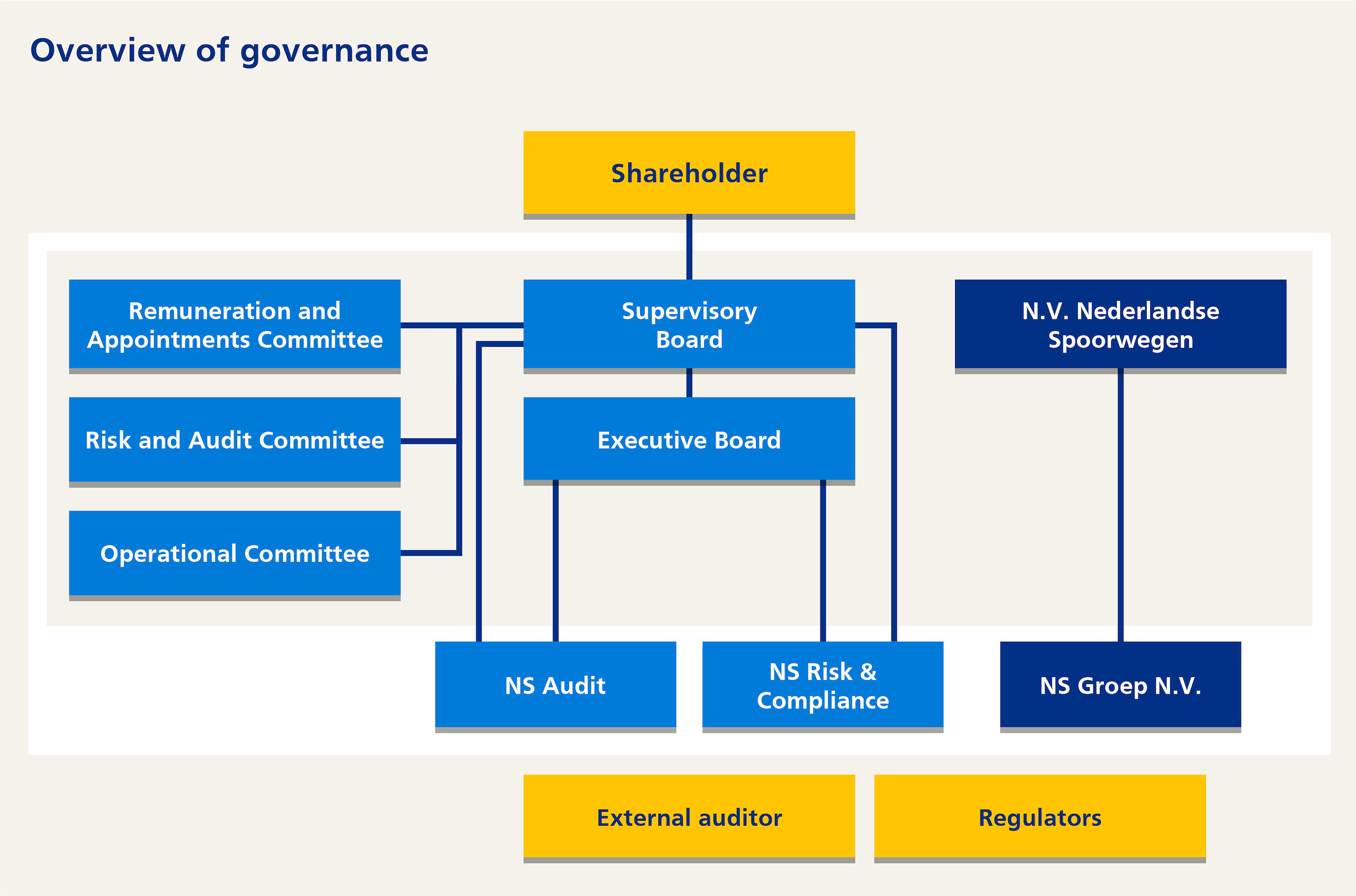
The governance of NS is based on the modified two-tier company regime.
Governance framework
NS’s governance structure is based on Book 2 of the Dutch Civil Code and the Corporate Governance Code. The Railways Act, the Competition Act and the Policy document on state-owned companies also affect NS’s governance. The structure is detailed in NS’s Articles of Association and in various internal regulations, which are published on the NS website (new window).
Corporate Governance Code
As a major enterprise with a significant role in Dutch society, NS attaches great value to a sound governance structure. Although not a listed company, it still applies the Dutch Corporate Governance Code (“the Code”), partly in light of the Policy document on state-owned companies. Given that NS is not a listed company and does not have a one-tier management structure, several elements of the Code do not apply to it. NS accounts for its compliance with the Code's principles and best practices on its website.
Shareholder
The sole shareholder of NV Nederlandse Spoorwegen is the Dutch State. The role of shareholder is performed by the Minister of Finance. Key powers of the shareholder under the Dutch Civil Code include appointing and dismissing the Supervisory Board and, under the mitigated structure regime, appointing and dismissing members of the Executive Board on the recommendation of the Supervisory Board. It also has the power to determine the remuneration policy, approve major investments, adopt the financial statements and approve the proposed profit appropriation. Additionally, NS’s Articles of Association stipulate that the shareholder is to be consulted in the formation of the strategy.
Annual General Meeting
The Annual General Meeting takes place within six months after the close of the financial year. The following topics are discussed at this meeting:
discussion of the report of the Executive Board
adoption of the financial statements and profit appropriation
discharging the members of the Executive Board from liability for their policy work and the members of the Supervisory Board from liability for their supervision
adoption of the result and profit appropriation
any notification of intended appointments of Supervisory and Executive Board members and of anticipated vacancies on the Supervisory Board
other proposals put forward and announced by the Supervisory Board, the Executive Board or shareholders and other persons entitled to vote, together representing at least one-tenth of the issued capital, with due observance of Article 37.
The Executive Board, the Supervisory Board and the shareholder are free to convene extraordinary general meetings as often as they wish.
NS Audit
NS Audit provides independent and objective assurance and advice on the adequacy of governance, risk management and internal control measures. This supports the achievement of NS's objectives and promotes continuous improvement in its operations. Every year, NS Audit draws up an annual audit plan that is adopted by the Executive Board and the Supervisory Board.
NS Audit is immediately subordinate to the Executive Board. With effect from the new portfolio allocation as of 1 April 2025, the NS Audit Director will report to the NS Chair and CEO. The NS Audit Director also reports to the chair of the RAC. The NS Audit Director has direct access to the chair of the RAC, the members of the Executive Board, the members of the Supervisory Board and the external auditor. The NS Audit Director attends RAC meetings.
External regulators
NS has to deal with external regulators who, among other things, monitor NS’s compliance with specific laws and regulations. Key regulators:
The Netherlands Authority for Consumers and Markets (ACM), which monitors compliance with the Competition Act and, specifically in relation to NS, compliance with the Railway Act and the Passenger Transport Act 2000.
The Dutch Data Protection Authority (AP), which monitors compliance with statutory rules on the protection of personal data.
The Human Environment and Transport Inspectorate (ILT), which oversees the safety of passenger transport and maintenance operations.
The Netherlands Labour Authority, which monitors compliance with laws and regulations of the Ministry of Social Affairs and Employment, including working conditions.
The Dutch Authority for the Financial Markets (AFM), which supervises insurers and other financial service providers. With its internal insurance business, NS falls under the Financial Supervision Act and AFM supervision.
The Netherlands Food and Consumer Product Safety Authority (NVWA), which monitors compliance with laws and regulations of the Ministry of Agriculture, Nature and Food Quality, including the Commodities Act.
External auditor
The General Meeting appoints the external auditor on the recommendation of the Supervisory Board. KPMG has been the external auditor of NS with effect from 1 January 2024. The external auditor reports to the Supervisory Board and the Executive Board with regard to the audit it has conducted. After the examination and audit, the external auditor issues an opinion on the integrity of NS’s annual report and financial statements. Read the auditor’s audit opinion and assurance report here.
The external auditor attends the meetings of the Supervisory Board at which the report on the audit of the financial statements is discussed. The external auditor is available for the general meeting at which the adoption of the financial statements is discussed. The external auditor also attends the meeting of the Supervisory Board held to discuss the six-monthly figures. In principle, the external auditor attends RAC meetings, unless the RAC determines otherwise. The RAC reports annually to the Supervisory Board on the functioning of and developments in the relationship with the external auditor.